


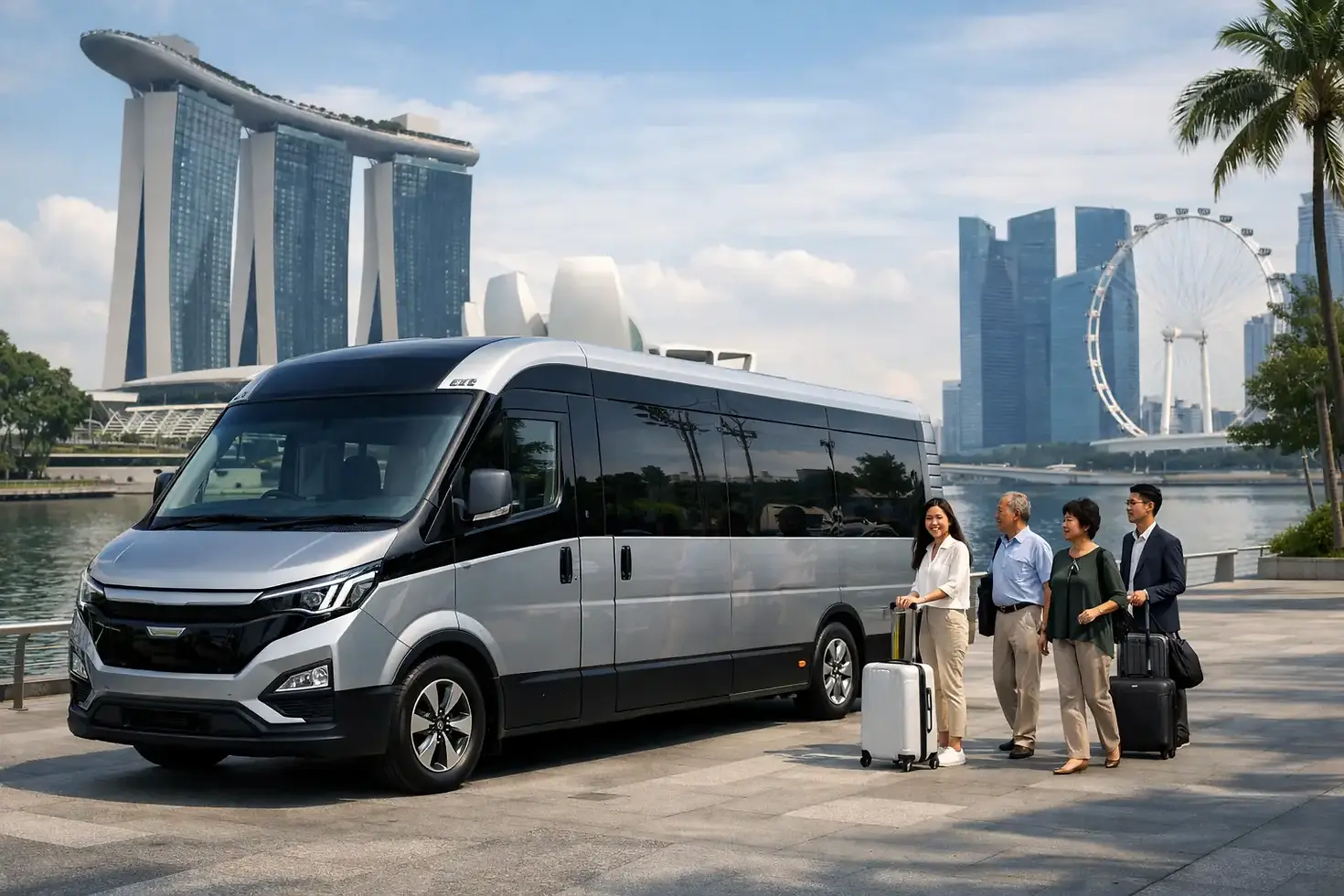
Farizon EV MaxiCab for Singapore Group Travel
- 21 hours ago
- 6 min read
A Farizon EV MaxiCab may look like a straightforward answer to cleaner group transport, but the vehicle only works well when its passenger layout, luggage space, charging plan and duty cycle match the booking. For airport groups, staff routes and private charters, the practical question is not simply whether the vehicle is electric. It is whether it can complete the required journeys on time, comfortably and with enough usable capacity.
What a Farizon EV MaxiCab is suited to
Farizon is associated with electric commercial vehicles, including van-based platforms that can be adapted for different transport roles. In a maxi cab setting, an electric van can provide a quiet, spacious option for small groups, hotel guests, corporate teams or event passengers who prefer lower-emission travel.
Its strongest use case is predictable urban work. Point-to-point transfers within Singapore, planned airport runs, hotel shuttles and scheduled staff transport are generally easier to manage because routes, timings and charging windows can be planned in advance. A vehicle returning to a depot or regular parking location can recharge between operating periods rather than relying on public charging during a live job.
It may be less suitable for a full day of irregular bookings with heavy luggage, late changes and long empty repositioning journeys. Electric vehicle range is affected by passenger load, air-conditioning use, traffic conditions, driving style and the charging infrastructure available. Those factors matter more than the headline range figure quoted for an empty vehicle under test conditions.
Passenger seats and luggage are separate decisions
A common booking mistake is to treat seat count as total capacity. A maxi cab carrying six passengers with cabin bags has very different space requirements from six passengers arriving at Changi Airport with large suitcases. A van can technically have enough seats while still being the wrong vehicle for the luggage load.
Before allocating a Farizon EV MaxiCab, confirm the actual passenger configuration. Vehicle conversions can vary, and a commercial van may be arranged for passengers, parcels, equipment or a mixture of all three. The final layout must provide proper passenger seating, seat belts, access, ventilation and safe luggage restraint. Folding or removable seats can add flexibility, but they should not be used to promise space that is impractical once every passenger has boarded.
For airport transport, ask for the number of large check-in suitcases, cabin cases, prams, golf bags or bulky items. For corporate and event transport, identify whether passengers will bring exhibition materials, cameras, uniforms or product samples. This allows the dispatcher to decide whether an electric maxi cab is suitable or whether a luggage van, larger minibus or separate support vehicle is the better operational choice.
A practical capacity check
For a simple transfer, match the vehicle to three facts: the number of passengers, the size and quantity of luggage, and the distance between jobs. If any one of these is uncertain, allow more room rather than booking to the absolute limit. A comfortable vehicle allocation reduces loading delays and avoids the need for a second vehicle at the kerbside.
Range planning matters more than brochure figures
Electric maxi cab operations need a working range, not an optimistic range. The working range is the distance available after allowing for traffic, air-conditioning, passenger weight, route diversions, collection waiting time and a sensible battery reserve. In Singapore’s warm climate, air-conditioning is a service requirement, not an optional feature, so it should always be included in planning.
Airport transfers are a good example. A single run may be comfortably within range, but the job often includes travel to the collection point, waiting, the passenger journey, a possible return trip and travel to the next assignment or charging location. Add several back-to-back bookings and the real operating distance rises quickly.
For scheduled work, set a clear charge threshold before dispatch. Do not send a vehicle out on the assumption that a convenient charger will be vacant later. Public charging can be useful as a contingency, but dependable service is built around planned charging at a known location. Fast charging can shorten downtime, although repeated high-power charging may need to be managed as part of fleet maintenance and battery-care policy.
When an electric maxi cab works best
A Farizon EV MaxiCab is most attractive when journeys are organised rather than improvised. Hotels can use one for planned guest movements. Companies can allocate it to fixed office routes or staff shifts. Event organisers can schedule dedicated loops between venues, stations and accommodation. These jobs make it easier to control vehicle mileage and charging.
The vehicle can also be a good fit for premium private travel where a quiet cabin and lower tailpipe emissions support the passenger experience. However, premium service still depends on the basics: a clean interior, polite chauffeur, clear collection instructions, working air-conditioning and enough room for everyone’s belongings. Electric power alone does not create a premium transfer.
For a late-night airport collection, last-minute group booking or a cross-border transfer to Malaysia, suitability depends on the confirmed route and operational support. Cross-border work adds distance, immigration timing and charging considerations, so a conventional maxi cab or another fleet category may sometimes be the more reliable allocation. The right choice is the one that protects the passenger schedule, not the one that sounds most environmentally progressive.
Charging should be part of the booking plan
Charging is a fleet-planning task, not something passengers should have to think about during their journey. Operators should know where the vehicle will charge, how long it needs, who has access to the charging point and what happens if the planned charger is unavailable.
For hourly charter work, this is particularly important. A charter can involve stop-start journeys across the island, waiting with the air-conditioning on, unexpected extensions and changes to the itinerary. A booking that appears short by driving distance may still use considerable battery capacity over several hours. Build charging time into the schedule before accepting the charter duration and route.
Where the itinerary cannot accommodate a charge stop, dispatch should use a vehicle with sufficient remaining range for the whole assignment and reserve. This is also why fleet variety matters. An electric maxi cab may suit the first assignment of the day, while a larger diesel or hybrid vehicle may be the sensible choice for a long, luggage-heavy or variable itinerary.
Fleet selection for operators and bookers
For transport coordinators, the Farizon EV MaxiCab should be one option within a wider dispatch plan. It should not replace every vehicle category. Smaller groups with light or moderate luggage may benefit from an electric maxi cab, while larger groups may need a 13-seater, minibus or coach. A business moving equipment alongside people may require a dedicated luggage van instead.
MAXI-CAB.COM approaches vehicle allocation by matching the booking to passenger numbers, luggage needs, route and timing. This avoids the false economy of choosing the smallest available vehicle, then facing delays, overcrowding or an additional vehicle charge on the day.
Bookers can help by giving complete information at the outset. State the collection and destination addresses, flight number where relevant, passenger count, luggage details, special access needs, charter hours and any fixed arrival deadline. If the booking involves wheelchairs, large musical instruments, sports equipment or multiple stops, say so before confirmation. These details determine whether an electric maxi cab is appropriate and whether charging can be scheduled without affecting the service.
Questions to ask before confirming a Farizon EV MaxiCab
Ask whether the quoted seating capacity is the actual passenger layout, not merely the maximum possible configuration. Confirm how much luggage can be carried with every seat occupied, and whether the vehicle has space for any special items. For recurring jobs, ask how charging will be managed between shifts and what replacement vehicle procedure applies if the vehicle is unavailable.
It is also sensible to check the charter terms. Find out whether waiting time, additional stops, late-night work, airport charges or itinerary extensions affect the price. Clear booking terms are especially valuable for company transport and event movements, where one delayed vehicle can affect many passengers.
The best electric transport choice is the one that feels routine to the passenger. When the Farizon EV MaxiCab has the right layout, sufficient real-world range and a planned charging window, it can deliver quiet and capable group travel without adding uncertainty to the journey.


Comments